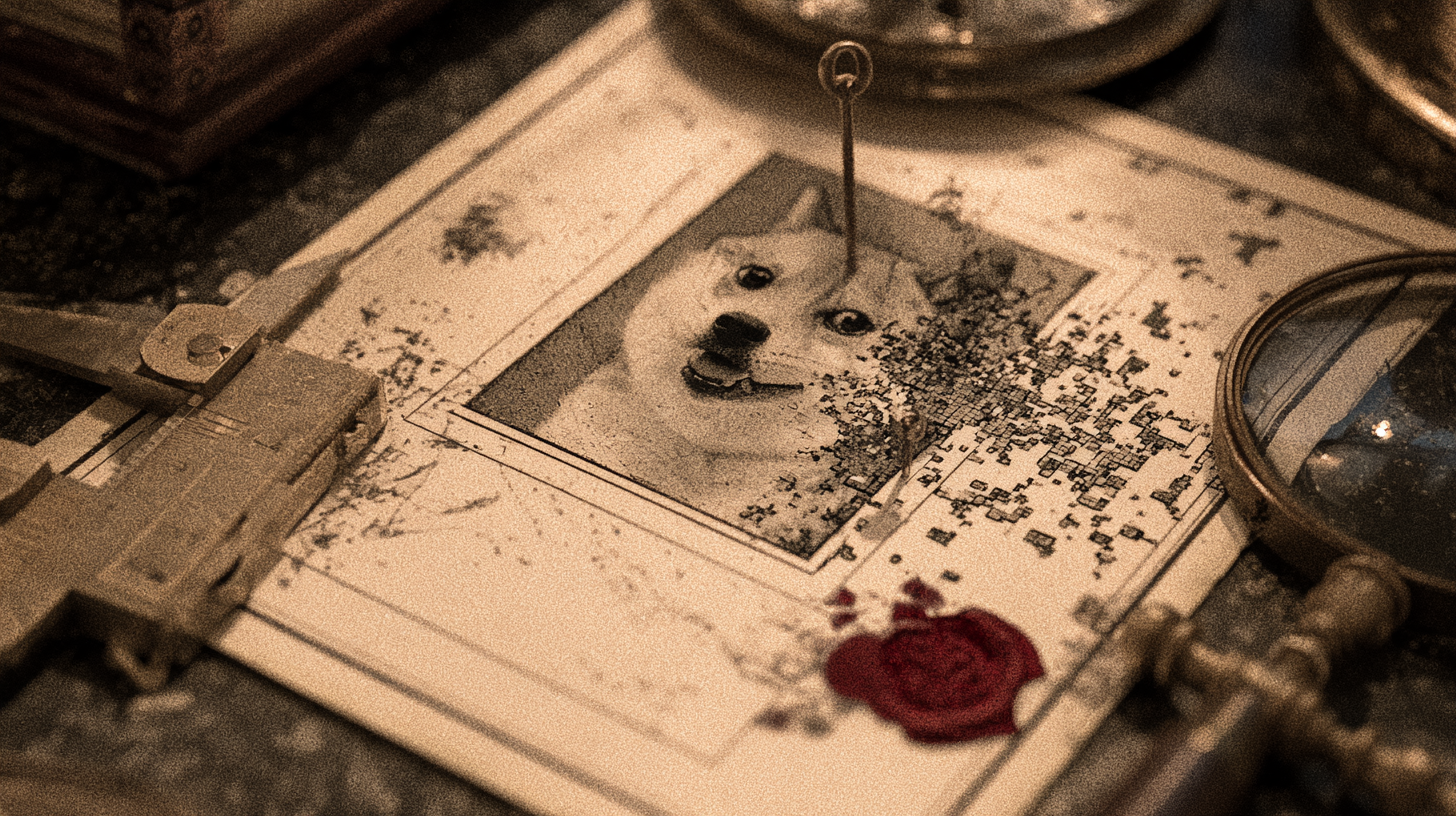
Part 5/7 of the essay series “Slang of Content Nerds to Art and Back”
For a historically brief moment, the image counted as proof of reality. That era can be said to have ended, at the latest, in 2025–2026, when generative AI took the image’s power of proof without passing it on to anyone. Everything that looks chaotic in today’s memes — the nostalgia movements, the return of rawness, the accelerating tempo, the programmatic demand for sincerity — can be organized around the collapse of a single concept: the index, the causal trace. And the one trace that survived did not die; it was privatized.
I. When a Picture Counted as Evidence
There was a brief historical era when a photograph was evidence. In 1880s Paris, Alphonse Bertillon built a system for identifying criminals around one idea: the camera does not lie, because it does not interpret. Light strikes the subject, passes through the lens, and leaves a trace on the plate. Between the image and reality runs a causal chain that cannot be broken after the fact. Courtrooms accepted the photograph as evidence, newspapers as a guarantee of truth, family albums as the archive of memory. All for the same reason. The picture claimed nothing. It had happened.
In that same turn, painting lost something it had never thought of itself as owning: the monopoly on documentation. Nobody needed a portrait painter anymore to prove what someone looked like. And art reacted in a way that defined the century that followed. It stopped competing at proof and moved to what only it could do: impression, structure, eventually pure form. Modernism is in many ways the story of what happens to image-making when evidentiary power fades.
In 2025–2026, meme culture went through the same turn, only in the other direction. Photography took evidentiary power away from painting and claimed it for itself. Generative AI took evidentiary power away from the image and gave it to no one. And everything that looks chaotic in the current currents — the nostalgia movements, the return of ugliness, the accelerating tempo, the programmatic demand for sincerity — organizes itself around a single concept, once you agree to see it.
II. The Machine: Icon, Index, Symbol
Semiotics was last in fashion roughly when memes circulated as photocopies. That’s fine. Concepts don’t expire with fashion; they wait for the situation that needs them, and we now have exactly such a situation at hand. One of the founders of the entire field, Charles Sanders Peirce, divided signs, starting as early as the 1860s, into three kinds according to how they connect to their objects. An icon resembles its object, like a portrait or, say, a map. A symbol means its object by convention and more conceptually, like a traffic sign or a word. And an index is connected to its object causally: smoke is directly connected to fire, a footprint to a foot, a weathervane to the wind. The index does not depict and does not claim; it is a consequence. That is why it is the only kind of sign that proves.
In the 1970s, art historian Rosalind Krauss noticed that the art of the day was moving toward the index: toward the photograph, the trace, the imprint of the body, documentation. When symbol systems were no longer trusted, art sought credibility in the causal trace. Worth remembering, because the same move will recur later in this text. But first we need to look at what happened to the index.
Meme culture, you see, rested on the index more deeply than is usually realized. The previous part’s field guide was built entirely on reading traces: a font is a trace of an era, compression errors and watermarks are traces of circulation history, deep-frying in turn is a trace of repetition. A meme could be dated and located the way an archaeologist dates a potsherd: by stratification. The entire literacy was forensics.
But in 2025–2026 that forensics stopped working. Not all at once and not everywhere, but structurally and irreversibly. The next four chapters walk through the current currents, and each one turns out to be a different face of the same event: the collapse of the index.
III. Hyperreal: The Severed Chain
In the fall of 2025, OpenAI unveiled Sora 2 — at once a video generator, a TikTok challenger, and a social network whose cameo feature turned the user’s own face into a playable character. The app was shut down as early as March 2026, but that was not the point. The model lived on, and perhaps surprisingly, it was above all its barely-introduced aesthetic that took on a life of its own. In the feeds of 2026, memes often looked indistinguishable from reality, and entire viral moments were born and gone in days.
Journalist Scott Rosenberg put what happened more precisely than anyone: for a brief historical moment, video had been proof of reality — now it became a tool of unreality. The sentence is worth reading in Peirce’s vocabulary. Video was the last mass medium in which there was, by default, a causal chain between surface and reality. Images had been manipulated for decades, but moving pictures with sound were, for most purposes, too expensive to fake, so their indexicality held. Generative video did not make faking easy. It made it free. And when producing a trace without an object costs nothing, the trace stops being a trace. Smoke proves no fire when everyone carries a smoke machine in their pocket.
This is where part two’s dissident analysis gets its mechanism. Aesopian language rested on deniability being rare and laborious. The surface to hide beneath had to be built by hand. Now deniability is the environment’s default state. The censor cannot demand a confession, because nothing is confessable; but for the same reason the dissident can no longer control their surface, because no one controls the surface. The mask does not grow onto the face. The face and the mask are the same flesh now. “Long live the now flesh!” — the words on which a Videodrome updated to the present day might well end.
IV. Ugliness: The Counterfeit Trace
The first visible consequence of the index’s collapse was somewhat strange (but also profoundly significant): bad quality got its evidentiary power back. Low-production-value content feels more natural in the feed and more credible on an emotional level. Audiences increasingly associate heavy polish with distance, scripting, or advertising intent. When smooth perfection points to the machine, shakiness points to a hand — and the hand to a human.
But look at this through the machine and you see what actually happened. Bad quality used to be an index: deep-frying was a causal trace of an image’s journey through thousands of saves and re-compressions. It could not exist without circulation, just as a footprint cannot exist without a foot. Now bad quality is merely a symbol that performs an index: a deliberate choice, a mark of authenticity used because it is read as a mark of authenticity. The noise is added afterwards. The shake is simulated. Same surface, opposite kind of sign.
This is the sign-flip of the field guide’s third rule, and now it has a theoretical explanation: the rule read traces, but the traces have turned into claims. And the counterfeit index is, of course, just another stylistic device — that is, already half-captured at birth. The same movement includes AI becoming the target of memes: the memes mocking AI slop flyers and the clanker imagery adopt the machine’s mode of production in order to mock it. It is the current form of stiob. Over-identification. So complete that the parody cannot be proven parody. Note the verb: proven. That, too, is an index problem.
V. The Great Meme Reset: A Trace by Decree
And then meme culture tried to fix the problem by proclamation.
In the fall of 2025, a demand began circulating on TikTok: memes would be reset on January 1st, 2026, and returned to their 2016 state. Away with brainrot, back to rage comics and advice animals. The idea arose as a reaction to the spring 2025 “meme drought” and the fall’s flood of forced TikTok memes. Its origin traces to a creator who joked about a reset in a sketch — and whose joke others took seriously. All the structural parts of a manifesto were present: a program, an enemy (brainrot and AI slop, which the makers called outright “content pollution,” in language that was ecological and moralistic rather than ironic), a utopia (an idealized 2016), and a deadline (the first day of the new year, almost evangelically). In the vocabulary of part one: the structure of an avant-garde without the avant-garde. Dada needed the art institution as its adversary. The Meme Reset took as its adversary meme culture itself.
Naturally, the reset failed, and seen from this essay’s reality the reason was obvious: authenticity cannot be proclaimed. An index is by definition a consequence. A proclaimed trace is a claim — that is, a symbol — that is, exactly the thing the proclamation was made against. The reset tried to restore the causal chain by decree, which is logically the same as ordering smoke to prove fire. So the outcome was not an accident but a necessity: old memes flickered through the feeds for a moment, and the Great Meme Reset itself became a meme. The recuperation that took a decade from, say, punk now took ten days.
Cultural theorist Svetlana Boym‘s analysis of nostalgia sharpens the picture. Boym distinguished restorative nostalgia, which wants to rebuild the lost literally, from reflective nostalgia, which lingers in the longing itself, knowing there is no return. The reset was restorative in program: on January 1st, 2026, we return to the state of ten years earlier — but it succeeded only as reflective. It became the culture’s way of mourning itself. The same double structure shows in the movement’s broader branch, the “2026 is the new 2016” aesthetic. Tens of millions of videos with 2016 filters, revived playlists, re-run mannequin challenges, disposable cameras, physical media… the driver a longing for the internet before gamification, monetization, and machine-made mass. Restorative surface, reflective content.
Linguist Adam Aleksic‘s counterargument deserves to be taken seriously, because it hits the same target from the other side. In his reading, the reset rested on a misreading. Italian Brainrot and the clanker were the first parody of AI at exactly the moment AI became culturally central. “6-7” began as mockery of clip-farming and became a meta-meme about the way memes are made. What looked like emptiness was commentary. And 2010s memes are no answer to 2020s questions. In other words, the “meaningfulness” the reset demanded was nostalgia for the style of meaningfulness: the longing was not for signs meaning something, but for what meaning-making looked like back when traces were still being left in ground that held.
One side-thread of the reset still deserves to be put on record, because it may prove the movement’s most lasting legacy: a shift in social norms whose slogan says indifference is the new cringe. Be caring, make cringe. It is the direct counter-movement to post-irony, a programmatic return of sincerity. After part three’s edgelord analysis, this is a significant turn. The protective layer of irony is becoming a burden the youngest makers no longer want to carry. We will return to this in the final part of the series.
VI. From Format to Tempo: Freshness as the Last Trace
The structurally deepest change is not any single style but the shift of emphasis from format to speed. Meme culture concentrates less and less on formats and more and more on the pace at which news-like events are remixed, on the absurdity of the moment, and on the feeling that the internet itself is one giant meme machine. Geopolitics is raw material the way television used to be. Maduro‘s arrest in January 2026 turned into viral meme material within days.
Seen through the machine, this is not arbitrary either. When no surface proves anything anymore, exactly one property remains that cannot be faked after the fact: freshness. A reaction to news within two hours stands in a causal relation to the news. It is an index, guaranteed by its timestamp. The same reaction two weeks later is anyone, machine or human, anytime, whatever. Culture did not flee from form to tempo on a whim, but because tempo is the last place where the trace still more or less works. The speed of circulation is not the art form’s decay; it is the art form’s migration to the only evidentiary axis it has left.
The genres of summer 2026 reflect this in practice. An escalation format like “Saxophone Gets Louder” builds its entire joke on timing: a situation collapses from “this is fine” to “oh no” in seconds, and the form lives in sound and rhythm, not in the image. “Twins at the Carousel” spread as animators’ handcraft in the middle of the generative flood. Craft itself as a trace of time, working hours as evidence. And “rare aesthetic” compilations gather oddly specific childhood clips, visual nostalgia for things that are not conventionally beautiful but land. The indexicality of archive footage, recycled into feeling.
VII. The Turn: Measurability as the Last Index
So far the story has run in one direction. The trace disappears from one surface after another, and the culture retreats onto an ever-narrower strip of evidentiary power. But one index did not disappear. It only changed owners.
Debord‘s recuperation, the capture of the subversive gesture as fuel for the spectacle, is now measurable in money. Meme marketing has settled into a business strategy whose campaigns reach roughly 60 percent organic engagement where traditional marketing graphics stall at about five. The generations have been segmented: chaos humor for Gen Alpha, relatable work-life content for millennials and Gen Z, nostalgia for Gen X… and “cozy” works on everyone. When the efficacy of the subversive gesture has been tabulated as percentages per demographic, the capture is complete.
But what is actually in that table? Engagement is a genuinely causal trace: it cannot exist without the real behavior of millions of people, clicks, dwell times, shares. It is smoke with a real fire behind it. With every surface stripped of evidentiary power, meme culture’s one remaining index is the metric. And the metric is the platforms’ property. Authenticity is not dead; it has been privatized. The causal chain now runs through a dashboard that the culture’s makers cannot access – but its buyers can.
This helps explain why the meme reset and the return of ugliness happened precisely now, and why they were also doomed from the start: they were escape attempts from measurability. But an escape attempt that succeeds shows up in the metrics, and is therefore captured next in line. The avant-garde paradox that took a decade in part one and ten days in this part is approaching its limit value: capture in real time, negation born pre-tabulated.
And here a seed of suspicion must be planted — one that deserves its own, larger text, but belongs to this spot too clearly to be passed over.
The last index, you see, is audited by no one. Smoke proves fire only if the owner of the smoke machine leaves the valve alone, and the owners of the metric have both the means and, reportedly, the will to adjust. X’s algorithm has been reported to weight its owner’s posts and political content in ways no outsider can inspect. Of the other platforms we do not know even that much. When the only remaining evidence is a privately owned number without an audit, evidentiary power stops being an epistemic question and becomes a proprietary one. And there is no reason to assume the owners are interested in measuring reality. It looks very much as if what interests them more is forcing their own reality on others. The metamorphosis of will into reality is at bottom a magical operation, far older than any platform. It has a long and often tragic history, whose reflections ripple through our own time in, for example, all manner of manifestation talk. But that is the subject of a separate essay — if not an essay collection.
VIII. The Bridge: Provenance Machines
And now Krauss’s observation returns, inverted.
The art of the 1970s fled from symbols to the index because conventions were not trusted but traces were. Today’s meme culture lives in a world where traces are no longer trusted either. Except in one place. The art institution is, at bottom, a provenance machine. Its entire function is to produce certified trace. Chain of ownership, signature, exhibition history, condition report… the museum and the gallery are an apparatus that proves this object has traveled this route through these hands. It is among the last institutions in society whose core business is the maintenance of the index.
That is why it is no coincidence that meme-makers are moving toward the art world right now. Nor is it mere status-seeking, as one might easily assume. A culture whose own traces have stopped holding seeks out the institution that can still prove something to be authentic. The gilded edge of the frame is not about dignity but about forensics. How that encounter goes — who enters the canon, on what terms, and what happens to a meme when it acquires provenance — is the subject of the next part.
- Ville Kiiski
A note on sources: the contemporary material in this part was verified in late July 2026, and it ages fast. Chapters 6 and 7, at least, should be re-checked before use. Which is, in its way, consistent: an essay about freshness as the last form of evidence carries its own timestamp as a trace. By the time you read this, the trace has already faded.
Leave a Reply