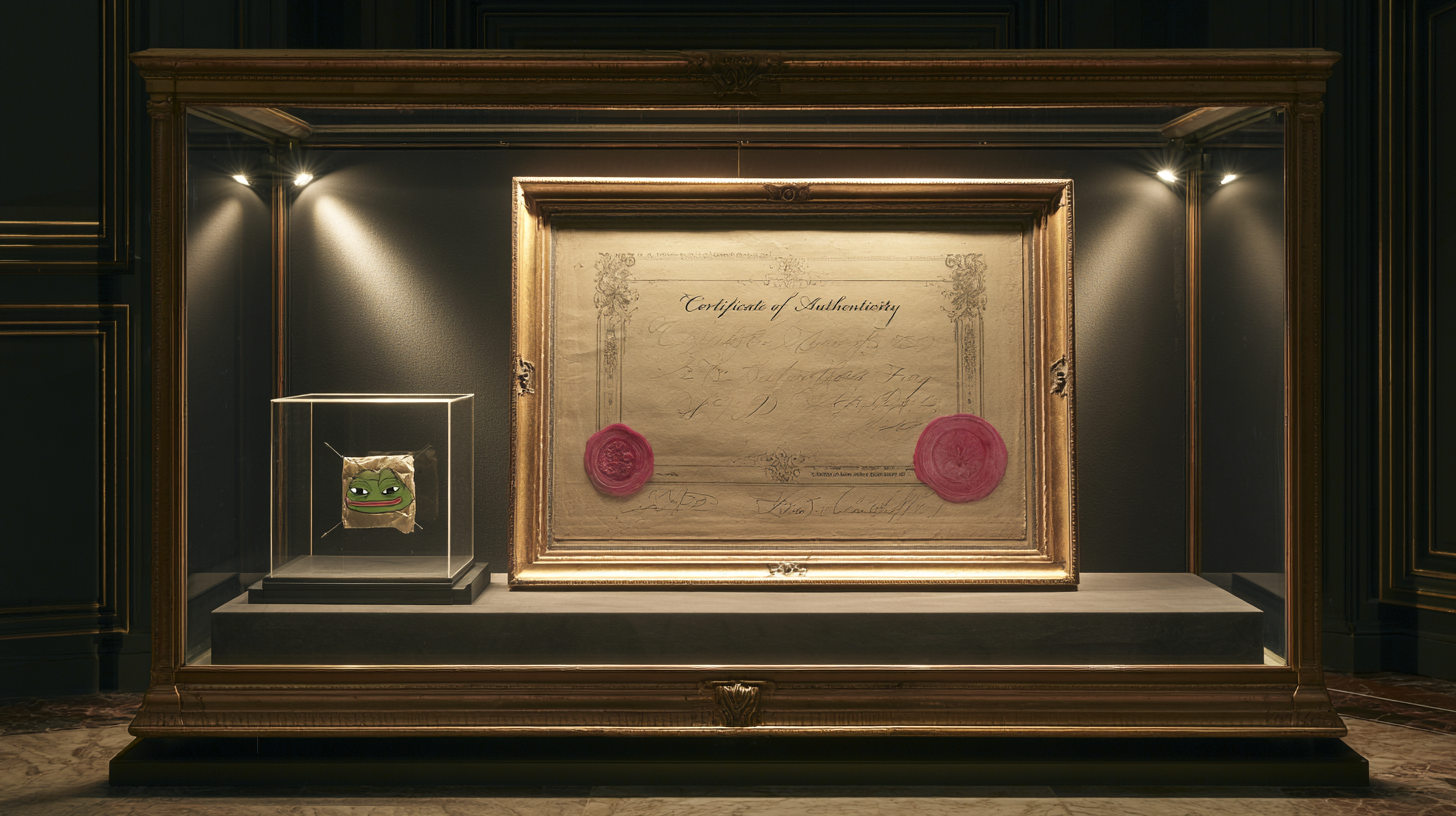
Part 6 of the essay collection “Slang of Content Nerds to Art and Back”
In November 2024, Sotheby’s sold a banana for 6.2 million dollars. The fruit itself cost 35 cents, so what was actually sold was an idea (which resembles a meme) and a certificate of authenticity (which is what art institutions are all about). The sixth part of the series follows the two-way osmosis between the art world and meme culture: art that behaves like a meme, meme makers whom the institution hires to mock itself, and folklore for which provenance is structurally impossible. The thesis fits in a single sentence: anonymous folklore lives in its form, whereas named art lives in the institution that recognizes it. Meanwhile, the art institution itself has become an ever more important part of the economy of meaning — and, through it, of our future.
I. Banana and Tape
In November 2024, Sotheby’s in New York sold a banana for 6.2 million dollars. Well — not exactly a banana. The fruit itself had been bought that same morning from a street-corner fruit stand for 35 cents, and for as long as the work is on display, it gets replaced with a fresh one every few days. What the buyer, crypto entrepreneur Justin Sun, actually got for his money was a certificate of authenticity, a roll of duct tape, and installation instructions. A few days later Sun ate the banana at a press event in Hong Kong, and Maurizio Cattelan’s Comedian survived intact. It could survive, because the work was never a banana in the first place. The work is the certificate.
Here is the entire machinery of today’s art institution condensed into a single piece of fruit. The previous part of this series ended with the observation that the museum and the gallery are, at bottom, provenance machines: the last institutions in society whose core business is the maintenance of the proven trace. The chain of ownership, the signature, the exhibition history, the condition report. A machinery that assures us this object has travelled this route through these hands. Comedian strips the machine naked: when the object costs 35 cents and is designed to rot, all that remains is the certifying function — and the price tells you what that function is worth on the market.
And Comedian is, at the same time, a meme. It memed itself within hours of its debut at Art Basel in 2019. The parodies, the fakes, the duct-taped cucumbers and phones spread faster than any press release, and this was not a side effect of the work but its operating principle. Cattelan did not make a sculpture that happened to spread; he made a spreading that happens to hold a sculpture’s papers.
This part is about the encounter the previous one promised: what happens when a culture whose entire mode of existence is copying without an original gets fed into the provenance machine? Who gets into the canon, on what terms, and what happens to the meme when it acquires provenance? The traffic runs in both directions — from the gallery to the streets and from the streets to the gallery — and it is precisely this two-way flow that makes the boundary interesting. It is not a wall but a membrane, and what passes through it is osmosis.
II. The First Art Meme
The machine is not new. In 1917 Marcel Duchamp bought a urinal from a hardware store, signed it “R. Mutt” and submitted it to an exhibition. Fountain was rejected, photographed, and lost: the original object has not existed for decades. The work lives on as a photograph and as authorized replicas, the best known of which were produced with Duchamp’s blessing in 1964. In museums around the world stand urinals, none of which is the urinal, and every one of which is fully authentic. Provenance without an object: exactly the structure Comedian repeated 107 years later with a piece of fresh fruit.
The Berlin-based artist Cem A., to whom we will return, has called Fountain the first art meme, and the label is not merely a joke. The readymade works exactly like a meme: it is prefab stuff, anyone can copy it, and its meaning comes from context rather than craftsmanship. But the readymade also exposed something the art world had preferred to keep as tacit knowledge: that the institution’s power of certification is not the frame around art but its content. A signature and a context suffice. The object is replaceable.
This is why memes bring nothing into the art world that was not already there. They merely make a little more visible a machine that has been running the whole time. The first part of this series argued that Dada won by dissolving into the tap water: its methods seeped into the everyday so completely that we no longer recognize them as borrowed goods. The readymade’s heir is the same lineage one generation on: a gesture that once blew up the concept of art is now the silent grammar of every screenshot.
III. Art That Behaves Like a Meme
The first current flows out of the gallery. A growing number of artists borrow from memes not their imagery but something more fundamental: the distribution model. The work’s true medium is not canvas, nor even the event, but circulation.
Cattelan is an old master of this genre, but the textbook example was supplied by Banksy. In October 2018 his Girl with Balloon shredded itself, by way of a mechanism hidden in the frame, seconds after being auctioned at Sotheby’s for roughly a million pounds. The gesture could be read as an attack on the art market. The art market responded in a way that tells you everything essential about the provenance machine. The half-shredded work was re-authenticated, given a new title, Love is in the Bin, and in October 2021 it sold in the same auction room for 18.6 million pounds — eighteen times its pre-shredding price. The sabotage did not break the machine; the machine digested the sabotage into a certified event and entered it into the provenance as added value. Institutional judo works in one direction only: whatever is done to the machine becomes part of the trace the machine produces.
The younger generation has taken the lesson and dropped the theatre of attack. The New York collective MSCHF releases its works as “drops” — limited editions designed to live primarily as screenshots and headlines: Jesus Shoes with Jordan water in the soles; sandals butchered out of Birkin bags; an ATM installed at an art fair that displays each user’s account balance on a public leaderboard. The genre is stunt plus screenshot. The physical object exists mainly because the circulating image needs proof that something happened — which is, to borrow the previous part’s vocabulary, the division of labour between index and icon turned into a production model.
In this current, the institution no longer certifies the object but the circulation of the event. And it does so gladly, because circulation is the one thing it cannot manufacture itself.
IV. The Meme as Material: Post-Internet
The second current flows in the same direction but through a different gate: artists who come from inside the institution (art academies, gallery representation, museum shows) take the internet’s imagery and logic as their conscious material. Around the turn of the 2010s the phenomenon acquired a name, post-internet: art that no longer treats the network as a medium, the way 1990s net art did, but as the space in which life is lived. The movement’s canonical group exhibition, Art Post-Internet, was staged at Beijing’s UCCA in 2014, and its participant list remains the single most usable map of this cohort.
From this essay series’ point of view, the cohort’s purest work is Amalia Ulman’s Excellences & Perfections (2014). Ulman built a five-month fiction on Instagram — a small-town girl come to the city, drifting into sugar dating, cosmetic surgery and breakdown — and a large share of her tens of thousands of followers took it for real until the reveal. The second part of this series described dissident art’s double coding: a surface credible to everyone except those who know to look otherwise. Ulman’s performance is that structure’s purest art form. The work functioned as a different work depending on whether the viewer knew they were viewing a work. And precisely that asymmetry was the work.
Jon Rafman’s 9 Eyes (2009–), in turn, might as well have been commissioned with the previous part’s conceptual toolkit: he trawls the images recorded by Google Street View’s automatic cameras — burning houses, fallen horses, men aiming guns — and frames them. A machinic trace produced by a camera without a photographer is converted, by a readymade gesture, into a work signed by an author. A stolen index acquires provenance. Around them spreads a wider field: Cory Arcangel, who emptied a Super Mario cartridge of everything but the clouds; Ryan Trecartin’s hyperactive videos, which anticipated the rhythm of meme editing years before TikTok; the DIS collective, which founded an ironic stock-image bank and thereby adopted an entire economic infrastructure as its form of institutional critique; and, as the field’s theorist, Hito Steyerl, whose essays on the circulation and impoverished resolution of images are this territory’s most cited literature.
The fourth part of this series drew a line between habit and awareness: between semi-automatic form production and the conscious study of form’s conditions. The post-internet cohort is that transition personified. They do not make memes; they study the things that define memes — circulation, deniability, resolution, the economics of distribution — and that is exactly why the institution recognized them as its own so quickly. The research posture is the academy’s mother tongue.
V. Meme Makers Inside the Institution
The third current runs against the flow: in from the streets. And its most visible case is an account that mocks the very institution that adopted it.
Cem A., who has a background in anthropology, founded the @freeze_magazine meme account in 2019 as a semi-anonymous Instagram profile whose subject is the art world itself: the hollow grandiosity of curator-speak, the class structure of galleries, precarious exhibition labour, the sociology of opening-night wine. The account gathered well over a hundred thousand followers. And then came the thing that is starting to look like a law in this series. Documenta, the German five-yearly survey of contemporary art and one of the heaviest gatekeepers of the European canon, invited him in 2022 to take part both as an artist and as a curatorial assistant. Since then, his career has run through the Barbican, Louisiana and ZKM. The meme maker became the institution’s adviser, with the job description of mocking the institution. A court jester’s post, in the word’s precise, medieval sense.
Cem A. is not alone. The British duo The White Pube fuses the meme format with critiques of class and decolonisation, and a generation earlier Hennessy Youngman had already shown on YouTube what art theory sounds like when performed by a character theory never invited.
And there was Jerry Gogosian. Hilde Lynn Helphenstein started the account anonymously in 2018 while recovering from an illness that had cost her her own gallery; the name crossed critic Jerry Saltz with mega-gallerist Larry Gagosian, and its biting memes about pricing politics, social climbing and insider hypocrisy made it the most followed voice in the field. The arc ran exactly along this chapter’s route. The identity was revealed in 2020. In 2022, Sotheby’s invited her to curate a selling exhibition whose title, “Suggested Followers: How the Algorithm is Always Right“, was itself a meme on the institution’s wall. And in the summer of 2025 she announced she was retiring the character: she had loved being Jerry, but it was time to let it go. On the last day of May 2026 she was found dead in a hotel room in São Paulo, at forty. No argument should be built on her fate, and this essay builds none. She is mentioned here because her arc — anonymity, exposure, the institution’s embrace, the letting go — is this chapter’s entire trajectory in a single human life. In Frieze, someone once pointed out the most essential thing about this phenomenon. The power of meme critique lies in the fact that its distribution machinery — free, platform-native, within anyone’s reach — sits outside the system it criticizes. The form and the target do not share an economy. The critique needs no gallerist’s permission to spread.
Except that the boundary leaks, and the embodiment of the leak is Brad Troemel. He began in 2009 with the Tumblr project The Jogging, which crossbred conceptual art with imageboard humour, and has since moved to Instagram to critique the art world’s economics, discourse and content logic directly in meme form — under his own face and name, which makes him an exception in a field whose functional norm is anonymity. Critics are sharply divided on him: to some he is the most essential voice of institutional critique in the 2020s, to others merely a skilled brand-builder who has discovered critique as a content vertical. From this essay series’ point of view, the dispute itself is more interesting than either position, because it replays the series’ foundational question exactly: when is command of a form art, and when is it efficient content production? The disagreement proves that the line runs through the assessor’s interpretation, not through the properties of the work. Just as the first part argued about habit and awareness.
Here it is worth pausing to ask the chapter’s obvious question. When the institution hires its parodist, which one digests which? The second part of this series described stiob: the over-identification that is indistinguishable from its master’s voice. In the court jester model the arrangement is inverted and somehow stranger still — the master pays the salary knowingly, frames the mockery, and hangs it on his own wall. The critique’s outsideness, that separate economy Frieze described, ends at the exact moment the critic receives the invitation. What remains is a question no participant can settle in their own case: is the critique that has been let in domesticated, or is it a Trojan horse now doing its work from inside? Both readings are always available, and neither can be proven. Deniability — another of the second part’s concepts — works here to the institution’s advantage. Has omnipresent governance, then, swallowed the last rebellion there was — and what follows from that?
VI. A Prosthetic Trace: The NFT Episode
Between these currents falls an episode that deserves a chapter of its own, because it tested the whole arrangement at its extremes. It was an attempt to bolt provenance onto a culture that has none. To detach the certificate from the institution and sell it separately. In the previous part’s language: it was something like an index prosthesis.
The NFT promised exactly what the provenance machine produces. A proven chain of origin — but without the museum, the curator and the walls, as a bare blockchain entry. For a moment it seemed to work. In March 2021 Christie’s, the very oldest core of the provenance machinery, auctioned a Beeple image collage for 69 million dollars, thereby lending three hundred years of accumulated authority to a new certificate market. That same spring, the “originals” of memes went under the hammer: Nyan Cat, Disaster Girl, Doge — images whose entire life had consisted of limitless copying, and for which uniqueness was now forged retroactively.
The episode’s most revealing case was its most modest. In May 2021 the Davies-Carr family auctioned the Charlie Bit My Finger video — 55 seconds from 2007, among the most watched clips of YouTube’s early history — as an NFT for 760,999 dollars. The scarcity was manufactured with a promise that takes the logic of provenance to its absurd terminus: the original video would be deleted from YouTube, so that the certificate would become the only remaining trace. The trace is destroyed so that the proof of the trace may inherit its value.
Then reality began to resist, and did so in three acts. First the family cancelled the deletion within days of the sale: the video would stay after all. Then, two months later, YouTube itself hid the video. A platform policy change that mass-privatized old unlisted videos took it out of sight for thirty months. And in January 2024 it came back, and it is still running. The view count is closing in on nine hundred million. The outcome is a perfect scale model of the whole episode. The seller could not keep the scarcity promise, the buyer’s certificate granted no power over the video itself, and the only party that managed to produce scarcity was the platform. By accident, as a bureaucratic side effect, and even then only temporarily. The network refused the scarcity that the certificate would have needed.
The collapse of the NFT market can be read in many ways, but for this essay the verdict is precise: a certificate without the institution’s other functions is a mere speculation coupon. The provenance machine is not a registry but a body. What makes a museum’s certificate valid is not the entry but the slow machinery around the entry: curation, which selects; care, which preserves; context, which confers meaning; and continuity, which promises that someone will still answer for the certificate a hundred years from now. Provenance cannot be outsourced, because it is not information. It is a relationship of care.
VII. The Canon’s Door and the Mechanics of Disappearance
Now we can answer the first of the questions the previous part left behind: who gets into the canon? The answer follows directly from the machine’s structure, for the provenance machine dictates its entry requirements through its own operating conditions.
The first condition is a recoverable author. The canon needs a signature — a name, or at minimum a certifiable pseudonym, behind which works can be chained. The second is a freezable object. From the circulating, mutating stream it must be possible to cut out an individual that can be framed, catalogued and insured. The third is market compatibility, preferably with the kind of critical register the institution knows how to tame onto its wall. Cem A. meets the conditions. Beeple meets the conditions. Matt Furie meets the conditions. Troemel meets them just barely, thanks to his face and because of it.
But now look at what falls outside the conditions. In practice, everything this essay series has been about. The chan nerds’ anonymous vernacular — the imageboards’ collective, authorless, perpetually mutating folklore — is by definition impossible for the canon, not for reasons of quality but of structure. And here it pays to be precise: the point is not that this culture has not yet gotten around to acquiring authorship and permanence. The point is that namelessness and evanescence are its operating conditions, in the same way that Aesopian language was the operating condition of dissident art. Anonymity permits risks that a face and a career would not: the author can say the thing, because no one can be pointed at.
From this follow three phenomena that are the field’s norm, not its malfunction. Exit: the account is closed by its own admin, out of boredom or fear of exposure. Disappearing in time is, in this culture, the honourable form of retirement. Removal: platform bans land with statistical certainty on precisely those operating at the edge of the permitted — that is, on precisely the most interesting. And renaming: the account returns under another handle, or the identity is distributed across parallel accounts so that the fall of one does not take the whole body of work with it.
There is a downright textbook-documented type case. Founded in 2019, @incellectuals — a shitposting account whose name self-ironically crosses the incel with the intellectual — was deleted from Instagram in May 2020. It rose again as @incellectuals2, and the series continued, numbered iteration by iteration, to at least the eighth, surrounded by a swarm of imitators and follower thieves. Disappearance is not a side symptom of this culture; it is its literally numbered, recurring structure. And note who counts the iterations: the Know Your Meme site dutifully records every version. A culture for which official provenance is impossible has grown itself a vernacular provenance machine. It is a proto-institution without walls, keeping a register of origins for objects that have no origin.
The small-language version of the same structure is one step more enclosed still. Finland’s intellectual meme culture lives in semi-closed groups more than on public accounts — closer to the second part’s shared-key model than to the shattered keys of international Instagram. A small language is itself a key.
From all of this follows the chapter’s conclusion, which is worth stating as simply as possible: anonymous folklore lives in its form; named art lives in the institution that recognizes it. That is why what passes through the canon’s door are meme culture’s ambassadors, not meme culture. Bartók gets into the concert hall; unlike the village fiddler from whom the tunes were collected. And if he did get in, he would cease to be a fiddler. As the old saying goes: the game is rough, and it is built on betrayal.
VIII. The Taxidermied Animal and the Living Population
There remains the third and deepest question: what happens to the meme when it acquires provenance?
The first answer is obvious and bleak. The meme’s mode of being is circulation and mutation. It exists only while copying and changing, as every part of this series has in some way observed. Provenance, by contrast, is arrest: one version is declared the original, framed, and separated from the stream. A framed meme is a taxidermied animal. It looks just like a living one, and that is exactly what is most dead about it.
But the first answer is too easy, and the fourth part’s field guide offers a more accurate picture. A natural history museum preserves the holotype: the one pinned individual to which the species’ scientific name is anchored. No one claims the species lives in the museum drawer. The species lives in the meadow; the drawer holds the specimen of record. The same double life is entirely possible for the meme. Matt Furie’s legal battle over Pepe the Frog demonstrated exactly this. Copyright and provenance reached the frog’s commercial uses, but never the population itself, which went on mutating in utter indifference to whose name is written on the holotype’s pin. Canonization does not kill the species. It prepares a single specimen.
And there is a third answer, the least fashionable of the three and perhaps for that reason the most important: the institution is memory. The platforms on which meme culture lives die. GeoCities was carted off, Vine was shut down, and any policy change can hide thirty months of internet history, as finger-chewing Charlie found out. The museum, by contrast, is built to outlive its owner. It is slow precisely because its time horizon is the century, not the quarter.
Rhizome, affiliated with the New Museum, has been archiving net art and online culture for nearly thirty years. It is an institution doing exactly the work that a culture of circulation cannot do for itself: keeping alive what the platforms have already forgotten. Provenance is not only capture. It is also care, and care is the one thing the stream will accept from an institution.
This belongs to those refinements of museum work that tend to go unnoticed by the general public (and especially by the boorish populists posing with scissors or chainsaws). By the former by accident; by the latter, often with deliberate cynicism. But that, too, is a subject for a separate essay collection.
IX. The Last Public Index Machine
Let us assemble the machine one more time, for its parts now settle into a pattern that extends well beyond the art world.
The previous part ended with the observation that the last meters of authenticity (engagement numbers, platform traces) have been privatized into closed dashboards whose owners have motives of their own. Against this background the art institution appears in a strange light: it is the last public index machine. Its chains of origin are auditable, its exhibition histories public, its certificates independent of what any platform owner wants the numbers to show. It is old-fashioned, slow, elitist and self-satisfied. And it is precisely these qualities that keep it working. Slowness is the collateral behind its certificates. In passing: even the art world’s greediest tip is not always content with this state of affairs. That debate played out quite visibly, for instance, in the run-up to the latest Venice Biennale, and I will return to it in detail in my report on La Biennale 2026 a little further down the road.
But the machine has a structural limit, which this essay has now drawn into view. The institution certifies individuals, not cultures. It can save the holotype, not the population; the ambassadors, not the people; Bartók, not the fiddler. The canon’s door is built to admit one person at a time, because the whole machine is built around the signature. And the culture whose entire vitality lies in signaturelessness remains, by definition, outside the door — which is where it thrives.
From this rises a question that is no longer art-historical. If the public certification of traces has shrunk into an institution that can process only a pinful of individuals at a time from the stream of culture, what would an infrastructure of authenticity look like that scales to the measure of a culture of circulation? A public provenance machine without gallery walls: auditable, independent of its owner, but built for the stream rather than the frame. That is a design question, and design questions are questions about the future.
The closing part of this series takes them up with the method of scenarios. What may happen next to meme culture — and, with it, to us. Do memes show the way for the rest of culture, or do they merely reflect the spirit of an age whose choreography is set somewhere else entirely — sometimes a full century earlier, at the Cabaret Voltaire, or in the urinal aisle of a French hardware store.
- Ville Kiiski
A note on sources: the contemporary material in this part was verified in August 2026. Prices, accounts and institutional line-ups go stale — except provenances, whose entire job is not to. Which is, in its way, consistent: an essay whose subject is the proven trace leaves behind a dated entry of its own.
Leave a Reply