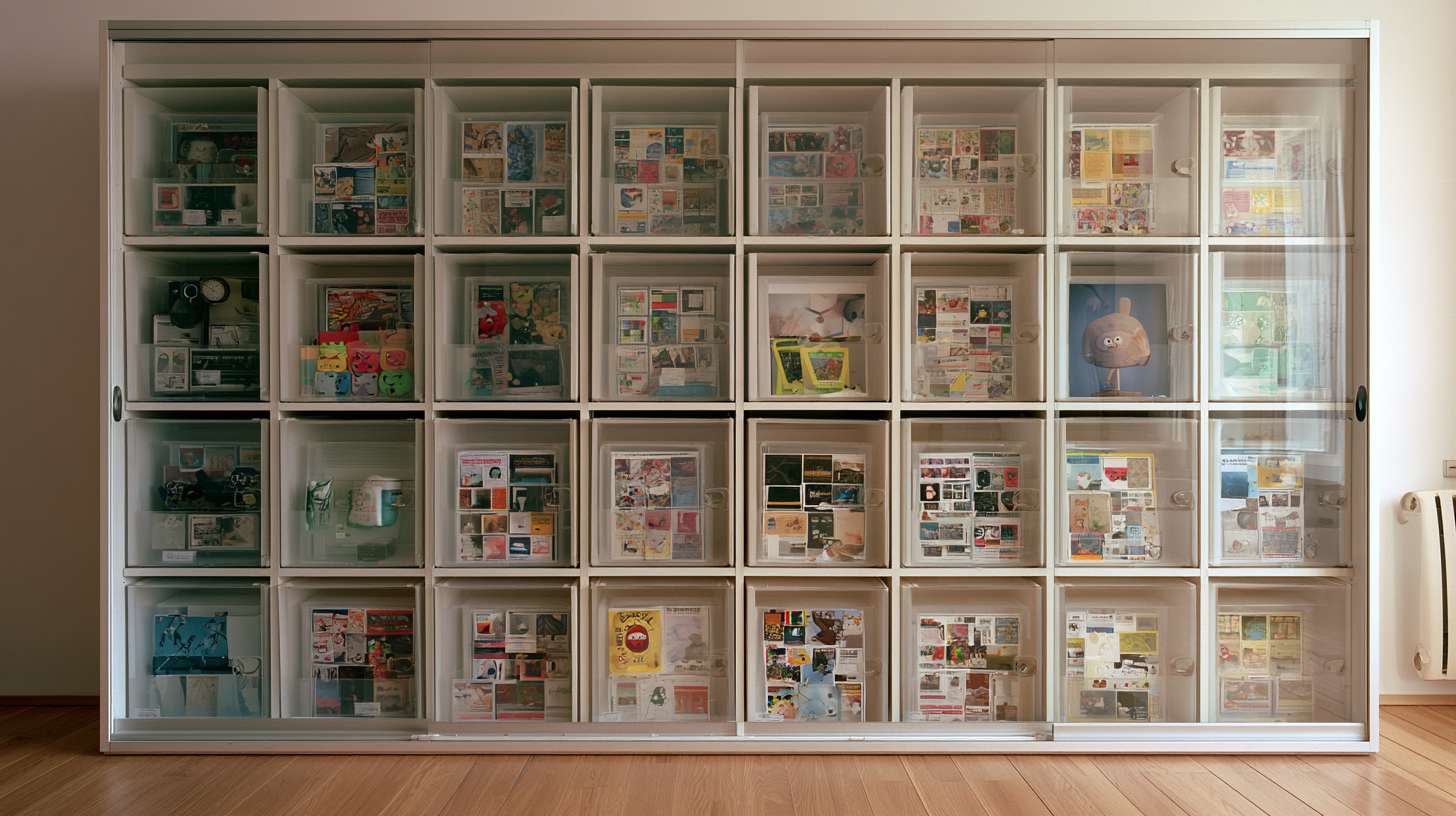
Part 4/7 of the essay series “Slang of Content Nerds to Art and Back“
A culture begins to exist at the moment when genres can be distinguished within it. Meme culture is starting to have all of culture’s equipment in place: a grammar, registers of irony, community dialects, historical self-awareness, and a merciless tribunal of taste called cringe. The fourth part of the series is a kind of field guide for reading memes in the wild: four axes along which the image stream organizes itself, and three signs from which a meme’s genre, age and circulation history can be read. Or could, until now. The warning is also a promise: after this, you will never look at your feed the same way again.
I. A Bourgeois Confession
The previous essay ended on a claim now worth making good on: a culture begins to exist the moment you can tell genres apart within it. When forms separate out of the noise, conventions out of the forms, and out of the conventions that quiet web of agreements against which a single act can be skilled or clumsy, obedient or rebellious.
The claim sounds innocent, but it is in fact fairly radical. It means that the very existence of genres is proof. A genre system does not arise by chance or by anyone’s decision. It arises when enough makers and readers have negotiated for long enough over what is good and what is bad, what is worn out and what is a classic, who has the right to which register and on what terms. Such negotiation is the hallmark of a culture. Not its content, but its structure.
A genre system always does three jobs, whether we are talking about academic painting, schlager, or the imagery of the imageboards. First, it distributes interpretive keys: recognizing the genre tells you how a work is meant to be read, and failing to recognize it shuts the reader out. Second, it builds hierarchy: some genres are prized and others despised, and that ranking is itself the community’s self-portrait. Third, it defines skill: only against a convention can a single act be virtuosic or clumsy, because without rules there can be neither rule-abiding execution – nor the clever breaking of them.
Meme culture has all three, and this essay sets out to map them. But a map alone would be just a list, and lists go stale. So the second half of this essay is something more practical: a reading guide. The first part of the series argued that the impression of emptiness is most often the limit of the viewer’s literacy, rarely a property of the work. That claim comes with an obligation. If the fault really is in literacy, it is only fair to teach literacy itself.
Here I must also admit the essay’s little performative trick, because honesty is cheaper than getting caught. An essay that distributes interpretive keys performs the very move this series has described from the start: it widens the circle of the initiated. Having read this, you will no longer look at your feed the same way. And that is precisely the point.
Meme culture can be organized along four axes: form, degree of irony, community dialect, and era. The same images circulate on all axes at once, so this is not a matter of mutually exclusive boxes but of registers. As in language, where the same sentence can be at once dialect, professional jargon, and parody. Let us take the axes in order, and run each genre through the machinery built in the earlier parts of the series: which genre runs on dada’s negation, which on the dissident’s encoding, which on the economy of transgression.
II. Form Genres: The Grammar
Form is meme culture’s grammar. The level even an outsider recognizes, without understanding a thing about the content.
The image macro belongs to the very core elements: image and text in a fixed arrangement. Its early heyday was the advice animals and the reign of the Impact typeface, roughly 2008–2013. The historical precedent is obvious: the emblem, that early-modern European genre in which image, motto, and explanatory text formed a fixed trinity whose meaning arose from the tension between the parts. Today Impact and white outlined text read as deliberately dated, and their use is itself a stylistic choice. “Boomer meme” is a genre category just as neoclassicism is. We will return to this under era strata, since it is precisely the fate of the image macro that shows how meme culture turns its dead forms into points of reference.
Rage comics (c. 2008–2012) were a library of crudely drawn stock faces for narrating everyday experience. They died as a form but bequeathed the idea of a shared cast of characters, which the wojak ecosystem inherited and expanded into a whole typology of human types: doomer, bloomer, coomer, NPC, soyjak, chad. Here meme culture reinvented something very old, namely characterology – the tradition running from Theophrastus through the commedia dell’arte to the seventeenth-century character book, in which human types are distilled into recognizable masks. Wojak culture is folk characterology, and like all characterology it is at once perceptive and cruel. The mask sees through its wearer but locks him in place. In the terms of the series’ third essay, the wojak stock is also a basic tool of the transgression economy, a ready-made repertoire of mockery whose every use is a statement about who gets to be the subject of the laughter and who its object.
Reaction images and GIFs are the meme’s purest slang form: a ready-made emotional expression attached to a conversation like a punctuation mark. Copypasta is the textual counterpart of the same thing, a ritually repeated snippet of text whose value lies in recognizability, not content. Their precedent is not in art history but in liturgy and oral tradition. A settled phrase whose power is in repetition and whose repetition is an act of participation. No one asks what new thing “amen” says. These genres run on none of the series’ three mechanisms, and that is exactly what makes them important points of comparison. They are the zero level, the everyday small talk against which conscious work with form stands out.
Remix and template crossover is the form genre in which the first essay’s dada analogy ceases to be an analogy. Two or more recognizable templates are cut and pasted together so that the meaning of the resulting image depends on whether the viewer recognizes all the sources at once. Hannah Höch’s scissors and the meme-maker’s copy-paste are the same physical gesture in another material.
But the technique has a second function, one that opens up only in the concepts of the second essay: every added template raises the threshold of interpretation and narrows the audience that gets the joke completely. Remix is thus at once dada’s collage and the dissident’s multiple encoding, a form of negation used for the control of keys. It is meme culture’s most form-conscious technique precisely because it serves two aims at once.
Meme generators’ ready-made crossover tools and the field studying the genealogy of memes treat this as a mechanism of cultural evolution. New formats do not arise from nothing, but as crossings of old formats and contents. As in language, where new words are almost always combinations and loans of old ones.
Video memes traveled from Vine to TikTok, and in them a subtle but fundamental metamorphosis took place: the template became sound. The same audio lives beneath thousands of different images, and the audio meme is the most widespread of current forms precisely because you do not see it but hear it. A musicologist would recognize here the contrafactum, the centuries-old practice of writing new words to a known melody: a hymn to a tavern tune, a mocking song to a hymn tune. Meaning arises from the tension between the recognized base and the new surface, that is, from exactly the same montage principle as in the image meme, but stretched along the time axis.
AI memes are the newest formal-technical layer. Generated material makes possible templates you do not have to find but can order. In 2025–2026 the layer has matured from image to hyperreal video, and at the same time the machine-mass-produced stream of content, “AI slop,” has spawned its own counter-genres, from a new appreciation of handmade crudeness to mocking the machine in the machine’s own language.
This shift is so recent and so many-branched that it deserves its own treatment. The next part of the series is devoted to meme culture’s newest currents, and the AI layer is its lead. For now it is enough to note its place in the canon and the grammar. It is the first form genre whose production cost approaches zero, and, as the second essay showed, it changes the entire economics of deniability.
III. Irony Registers: The Axis Where the Default Becomes Deliberate
If form is the grammar, degree of irony is the axis on which the first essay’s central distinction – automatic versus conscious mode of execution – is made concrete as genres. This axis is meme culture’s own invention in the sense that in no earlier folk imagery has the degree of irony been such an explicit marker of genre. The registers proceed in layers, and each layer is a reaction to the previous one.
The wholesome meme means what it says. The wholesome register, in which warmth and encouragement are genuine through and through, arose partly in protest against the tyranny of irony. That paradoxically makes it a conscious stylistic choice: sincerity as a register is a different thing from sincerity as a state of affairs, and it is precisely that difference that makes it a genre.
The ironic meme uses the form in quotation marks. The so-called dank phase (c. 2014–2017) began to recycle worn-out templates as deliberately low quality, so that the badness was itself the joke. An art historian recognizes the gesture. Camp, the conscious embrace of kitsch, the “so bad it’s good” sensibility that Susan Sontag mapped as early as 1964. The dank meme related to Impact as camp related to 1950s melodrama — with a loving contempt that is contempt only in the outsider’s eyes.
The deep-fried meme takes irony into the material. The image is compressed, saturated, and filtered until it falls apart. This is meme culture’s sound poetry, and the analogy to Hugo Ball’s “gadji beri bimba” is more apt than one might suddenly imagine. In both, the medium is destroyed by the medium’s own means. Language broken down into phonemes, the image into compression artifacts, and the remaining ruin is the work. In the language of the series’ machinery: pure negation, dada’s direct descendant.
Surrealist memes abandon the structure of the recognizable joke entirely and build dreamlike, self-referential images, often with explicit dada and surrealist references. This is meme culture’s most self-aware art movement, the only register that openly acknowledges its art-historical precedents, and therefore also the one in which the first essay’s “threshold of awareness” is most clearly crossed. The surrealist meme-maker cannot claim to be merely making everyday chatter. A culturally recognizable reference is a confession.
Post-irony and meta-irony are registers in which the recipient cannot resolve whether the message is sincere or not — and the irresolvability is the point. Here meme culture approaches the second essay’s stiob: an over-identification that cannot be proven to be parody. The difference is in the control of keys, and that difference is the whole lesson of the series in miniature. The Leningrad band that belted out Soviet schlager loud and proud knew itself whether it was serious, and its inner circle knew too. The meta-ironic meme-maker does not always know even himself. Stiob was a precision weapon, post-irony is a weather condition. And as the third essay showed, it is precisely in this zone of irresolvability that the transgression economy runs hottest. Poe’s law guarantees that unmarked irony, in wide distribution, withers into surface, whomever it may originally have served.
Brainrot is the youngest generation’s own register of the 2020s. It is deliberately meaningless, hyperfast, and infantile-absurd imagery, the point of which is partly that it is unreadable to older generations. In it lives the ancient gatekeeping function of slang at its purest. And as noted at the end of the third essay, it is also an immune reaction to an environment in which every meaning has already been weaponized. The apparent emptiness often deceives. Many brainrot forms were commentary on their moment, some of it the first parody of AI, some of it satire of the very way memes are made. “Meaningless” here describes the limit of the viewer’s literacy, not necessarily the content of the work. On the irony axis, brainrot occupies an interesting double position. It is at once the slang end of the axis — pure, aimless circulation — and its zero point, from which the axis can begin again. After dada’s sound poetry came construction. What comes after brainrot is a question for the coming parts of the series.
Between the extremes of the axis, then, there is a clear order: from sincere use to conscious work with form and, through the destruction of form, to a new zero point. Meme culture’s irony registers repeat in a hundred months the arc that took art history a hundred years. That is not exaggeration but the metabolic rate of this culture, and we will return to it under the strata.
IV. Community Dialects and the Status Economy: Who Owns the Keys, Who Laughs Last
The third axis is social, and here the conceptual apparatus of the second essay — keys, the circle of the initiated, deniability — becomes the architecture of the genre system.
Every sufficiently tight community develops its own meme dialect, and the dialect works exactly like a sociolect in language: it is a proof of membership that cannot be forged quickly.
Niche meme pages — the memes of classical art, philosophy, a profession, or a hobby — use general templates with specialized vocabulary, and understanding the joke proves membership. This is the second essay’s “restricted circle of the initiated” at its most everyday: not forced by censorship but built by the community itself. A Latin quotation in the margin of a medieval manuscript and a specialized term used correctly in the wrong template do the same work. They separate the lettered from the unlettered, gently but unerringly.
Local and national meme cultures translate global forms into their own language and produce their own imagery that does not translate outward. Finnish meme culture is a good example, with its own characters and tones. Untranslatability is here too a feature, not a flaw. A folklorist recognizes the phenomenon instantly: a local tale lives precisely because it requires local knowledge, and its spread requires explanation and quickly dilutes its effect.
Political meme ecosystems deserve their own mention, because in them the failure to control the keys shows most clearly. The same character can live an entirely different life in different camps; Pepe the Frog’s journey from innocent comic character to political symbol and partly back is the best-known example of a sign’s drift that no one controls. Not even the character’s creator, who tried publicly and desperately to call his creation home. The entire analysis of the third essay was built on this. In wide distribution the keys scatter to the world at the very first sharing, and the meme carries through only its surface.
Corporate memes are the front line of recuperation: brands’ attempt to speak a slang whose whole value rested on its not being purchasable. The warning quoted in the first essay from Debord — that the spectacle absorbs the subversive gesture into itself and sells it back as style — comes true here at its most literal. But the community’s response is, for genre analysis, more interesting than the attempt itself. The failed attempt to worm into the audience’s good graces was turned into its own meme. Its best-known template is Steve Buscemi with a skateboard over his shoulder and the chilling opening line “How do you do, fellow kids?” A middle-aged man who thinks he blends into the youth by imitating their outward markers and words. The core of the joke is exactly the core of this chapter: command of the slang is a proof of membership, and membership cannot be bought. The buyer gets his hands on the vocabulary, but the very act of buying proves he does not have the slang in hand. And the community recognizes the forgery at a glance, just as a native speaker recognizes an accent.
And from this we come to what a mere list of slangs and dialects does not yet reveal: meme culture’s internal ranking. The genre system’s second job, the building of hierarchy, is as real in meme culture as in the nineteenth-century salons of Paris, even though it lacks any such institution.
At the top of the hierarchy is freshness: the form used first, at the right moment. Below it, form-consciousness: the remix that shows command of several layers at once. At the bottom are lateness and the wrong audience — the template that has already leaked into the mainstream; the joke the “normie” got to tell; the form the brand got to buy. This ranking produces exactly the same phenomena as the academic genre hierarchy of old. There is its own salon (the fast, reference-dense leading edge of the avant-culture), its own academy (established formats the broad public is only learning), and its own Salon des Refusés mechanism: the conscious embrace of a rejected and despised aesthetic as protest, of which the dank phase was a pure example and brainrot is the newest.
The central status currency, however, is negative, and it has a name: cringe. Cringe is the veto power of meme culture’s academic jury. Public proof that someone used a register whose keys he did not hold, or a form whose time was already past. The cringe economy is merciless precisely because it is decentralized. No institution pronounces the verdict; the verdict arises as the sum of thousands of small recognitions. And like all economies grounded tightly in taste, it is at the same time a conservative force. Fear of using the wrong register holds the borders in place more effectively than any gatekeeper. Bourdieu would have recognized this field instantly: distinction, taste as differentiation, cultural capital that does not convert into money but whose absence shows at once.
In this light the third essay’s edgelord analysis gains one more frame. The edgelord is a figure who tries to buy status with the one currency of the hierarchy whose acquisition requires no particular skill or sensitivity: the steepness of transgression. From the standpoint of the genre system it is the same move as the macho painter who tries to substitute canvas size for compositional skill, and the violence of his splashing for the sensitivity he lacks.
V. Era Strata: A Culture Reading Its Own History
The fourth axis is time, and it is the one axis that finally separates a culture from mere circulation.
Meme culture carries its history with it as strata of style. A rough chronology might go like this: the forum era (early 2000s: imageboards, early macros) → the Facebook and rage era (c. 2008–2013) → the dank and irony era (c. 2014–2017) → the wojak and post-irony era (c. 2018–2021) → the video and brainrot era (2021–2025) → the hyperreal AI era with its counter-movement (2025–), of which the next part of the series will tell more.
What matters is not even the accuracy of the chronology but what happens to the strata. They do not vanish but turn into points of reference. Using an outdated template is a statement. Nostalgic, ironic, or both, just as the alexandrine is in a twentieth-century poem or a baroque pastiche in a contemporary composition. The dead form is not gone. It has moved from vocabulary into quotation. This is exactly the mechanism by which art history has always worked, and its appearance in meme culture is a more significant event than any single style.
It means that meme culture, too, has begun to read its own history consciously.
The Great Meme Reset of early 2026, which the first part of the series treated from the avant-garde angle, is in this view the latest milestone in the chronology so far. It is the first time a whole stratum was attempted to be put back into use programmatically, equipped with slogans, a utopia, and a deadline. The attempt failed in a way already discussed, but its significance for genre history was left untold. The Reset proved that meme culture already has a canon, that is, a shared understanding of what in the past was valuable and worth restoring. A folklore that begins to argue about its own canon has ceased to be mere folklore. It has become a tradition, and tradition is the soil from which art tends to be recognized after the fact.
One structural change remains to be named, even though its full treatment belongs to the next part: the shift of emphasis from format to tempo. Increasingly, meme culture organizes itself not around recognizable templates but around the speed of remixing. Whole viral moments arise and vanish within days, and the sense of the internet as one giant meme machine is replacing the typology of individual forms.
From the standpoint of the genre system this is the same shift the art world made from work to process and from object to event. And that, in turn, makes every list of genres provisional in nature, this one included. We will return to that at the end, but before that let us still try to make good on the promise of literacy.
VI. A Field Guide: Three Tells
A meme’s genre can be read from at least three things, and grasping them turns the scrolling of a feed into close reading.
The font tells the era. Impact with white outlines is 2008–2013; a clean sans-serif in top and bottom bars is 2014–2017; text embedded in the image, often deliberately careless, is later; and the complete absence of text (a bare image whose context is elsewhere) is the present. The font is the meme’s isotope: it dates the sample however fresh the content, and that is exactly why the deliberate use of the “wrong” era’s font is always intentional communication.
Compression errors and watermarks tell the history of circulation. Every save and reshare leaves its trace on the image. Compression artifacts pile up, resolution drops, the watermarks of previous platforms layer up like destination stickers on the side of a suitcase. A ratty image has circulated long and far. It is the meme’s provenance, in the terms of the art trade.
From this follows the finest detail of the field guide: rattiness can be faked. A deliberate deep-fry borrows the authority of long circulation with the same gesture by which an antiques dealer patinas a new table. Which makes reading the history harder, but not impossible. And a true meme master, of course, “can tell from the pixels.” 😀
The contradiction between quality and subject tells the degree of irony. When technical quality and the subject’s tone are in line – a beautiful image for a sincere matter, a ratty image for a ratty joke – it is probably a natural, instinctive stylistic choice.
When they are deliberately in contradiction, as in a top-quality execution of an absurd subject, or a sincere message deep-fried, one can say with fair confidence that someone is handling the form consciously. The contradiction is the mark of awareness, and that is exactly what the first essay’s distinction between default mode of execution and conscious stylistic choice meant in practice.
The three tells work together like a language skill: at first you read them consciously, then they become a matter of ear. One reservation must nonetheless be made, and it is a weighty one. In 2025–2026 the sign of the third tell — quality — has begun to reverse. Low quality, which once was proof of the image’s long journey, is, in the era of hyperrealistic generated imagery, turning into a conscious claim of authenticity.
The same surface, then, carries the opposite meaning to what it did a decade ago. Recognition has not become impossible, but the basic question has changed. It is no longer enough to ask where this quality comes from. One must ask what this quality claims. That reversal is so fundamental that it gets its own treatment in the next part of the series.
VII. A Provisional Map of Living Terrain
This essay’s map goes stale. And staggeringly fast, at that. That is not a flaw but an observation, and in fact at the same time the final proof: only a living culture transforms so fast that its maps go stale in your hands. A dead language’s grammar gets finished; a living language’s grammar is always behind.
But what does not go stale is the structure of the system. Forms change, but the axis of form genres remains. Registers cycle, but the central question of the degree of irony — “Does the maker repeat the form out of habit, or does he work on it consciously?” — is asked of every new format anew. Dialects are born and die, but the economy of keys, the proving of membership, and the cringe tribunal go on with their work. And the strata fatten, which means that the store of references — the material conscious work with form draws on — keeps growing.
A culture that has a grammar, registers, dialects, historical self-awareness, and a merciless internal taste-tribunal is not noise. It is a culture awaiting its art history. Part of that history it has already received. The art world has begun to pick meme-makers into its canon, and of who they are and where they place on this map, the sixth part of the series will tell.
These days one must also remember that every system with a clear grammar, known conventions, and a tendency to live on repetition is also highly amenable to being produced by AI. And memes are a jigsaw of application, copying, and variation of meanings, that is, as if made for artificial intelligence. The degree of originality has to be high and the personality significant.
Before that, though, we must look at where the terrain is developing right now, for the years 2025 and 2026 have changed it faster and stranger than any earlier stratum.
- Ville Kiiski
In the next part: meme culture’s newest currents — hyperreal AI video, the turn of crudeness from trace into claim, the return of sincerity, and a culture that organizes itself around speed instead of form.
Leave a Reply