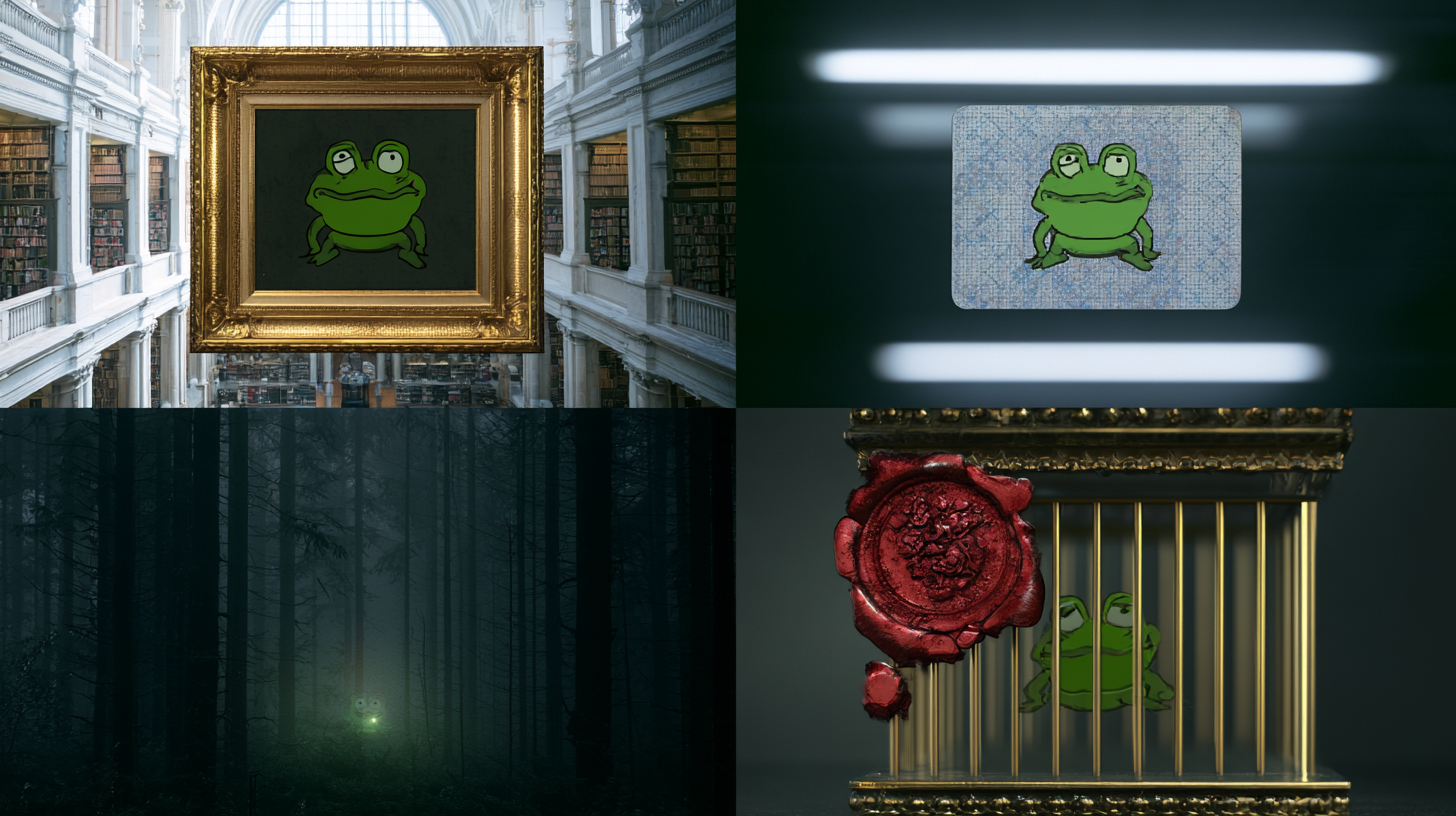
Part 7 of the essay collection “Slang of Content Nerds to Art and Back”
Two days before this essay was published, the EU began requiring synthetic content to be labelled — and was thereby forced to take a stand, at the level of law, on this series’ fundamental question: when is a meme art? The closing part gathers the six preceding essays into a single claim: meme culture is a complete authenticity system without an institution. It also uses the scenario method to map four possible futures, from the Cathedral to Certificate Feudalism. For memes are culture’s early warning system.
I. Back to the Future
Two days before this essay was published, on the second of August 2026, the transparency obligations of the European Union’s AI Act entered into force. Synthetic images, audio, video and text must henceforth be marked as machine-generated. Written into Article 50 of the law is also an exception that deserves a moment of silence. Artistic, creative and satirical content receives lighter treatment. Its labelling must not hamper the display or enjoyment of the work. In other words, the European legislator has set the enforcers of the law face to face with the very question this essay series has spent six parts on: when is a meme art? And resolved it by conceding that the line exists, even though no one can say where it runs.
The future this part speaks of does not, then, begin tomorrow. It began the day before yesterday, before we even managed to get the final part of this essay series out the door.
The series began in Zurich, in a small cabaret where, a hundred years ago, an attempt was made to redefine what counts as art. Six parts have since travelled in one direction. From slang to art: from Dada’s legacy to the dissidents’ double coding, from the edgelord’s responsibility to a field guide of genres, from the death of the trace to the gallery’s gilded cage. But the series’ name has promised, from the start, a return journey as well. This part redeems that promise, and does so in two ways. First by gathering six parts into a single claim, and then by asking, in earnest, what may happen to meme culture next — and what that might tell us.
To the latter there is no single correct answer, and that is precisely why there is a method. Scenario work does not predict; it maps. Four scenarios are not four wagers of which one will hit, but four maps for recognizing which way we are moving, and through which waypoints.
II. Six Machines
Each part of this series has defined one conceptual machine, and it is only honest to line them up for inspection before attempting to put them to more serious use.
The first part built dissolution: Dada won by mixing itself into the tap water, and its methods became the silent grammar of every screenshot. The second built three audiences and double coding: a message that is a different message depending on whose key unlocks it, and deniability, which is both shield and weapon. The third built two accelerationisms and four tests: it defined the difference between constructive and corrosive transgression, and attempted a craftsman’s ethics for anyone playing with fire. The fourth sketched a field guide: it defined the genres and dialects, and exposed the decisive difference between the manner of making and awareness of it. The fifth built the index: the trace that the synthetic image severed, and the metrics into which the proving of authenticity was privatized. The sixth built provenance: the canon’s door, the holotype’s pin, and the mechanics of disappearance.
Six machines look like six different subjects. But set side by side, they reveal the same question from six angles: how meaning is proven, to whom it is proven, and who owns the proving. Double coding is proof for a selected audience. The tests of transgression are an ethics of the burden of proof. The genre system is proof’s family of dialects. The index is proof’s technique, and provenance is its institution.
From this follows the series’ synthesis, which is worth stating outright: meme culture is a complete authenticity system without an institution. It solves exactly the same problems the art world solves with its provenance machine. Who is the author, what is authentic, what belongs to the canon, what is remembered. But it solves them without walls: with form, with speed, with the audience’s shared keys, and with plain-language archives like Know Your Meme. That is why the art world and meme culture recognized each other so effortlessly, and why trade is conducted at their boundary, as the previous part showed. They are not opposites. They are two occupants of the same office, one of whom holds the post and the other of whom does not.
But if meme culture is an authenticity system, its future depends on what happens to the infrastructure of authenticity. And that is, right now, genuinely and unusually open.
III. What Has Already Been Decided
Scenario work’s first distinction runs between predetermined forces and genuine uncertainties. Not everything is open. Part of the future has already been ordered and paid for, and it is worth recording dryly before speculating about the part that has not.
The first thing of which we can be nearly 100% certain: the marginal cost of synthetic content is falling to zero, and it is not coming back. The death of the index described in part five will not be reversed; the public stream fills with machine-made material regardless of what anyone thinks of it. Second: the platforms’ metrics remain private, and their owners have motives of their own. Third: regulation is coming — only its form is open. The labelling obligations of August the second are a beginning; Britain’s age verification and Australia’s minimum age are already in force, and EU member states are obliged to offer their citizens a digital identity wallet within the next few years. The obligation to prove is expanding everywhere. The question is no longer whether things get proven, but who owns the proving infrastructure. Fourth: the generation is changing. The first cohort raised entirely amid synthetic content is coming of age, and its authenticity heuristics — in the fourth part’s language, its manner of making — are calibrated to a different world than its predecessors’. Fifth: the attention economy is approaching saturation. There is no unallocated time left in the day, so growth will henceforth come from the redistribution of scarcity, which explains both the platforms’ accelerating desperation and the spread of withdrawal phenomena.
IV. Two Axes
The core of the method is to choose the uncertainties that are both genuinely unresolved and largest in their consequences. There would be no shortage of candidates, but most of the obvious-seeming ones fall away quickly on closer inspection. “AI versus human” will not do, because it is not an uncertainty but a driver. The arrival of synthetic content has already been decided. “Regulation versus freedom” will not do, because it is too crude. Regulation can produce almost any outcome, good or bad, depending on what it protects. From the machinery presented in this essay series, two more precise ones emerge.
The first axis is the infrastructure of the trace. In everyday language: who maintains the machinery by which it is determined whether something is authentic. Whenever you encounter an image, a video or a claim online, some party is in practice answering the questions is this real, who made this, has this been altered. At present the answering is done by the platforms’ own systems — recommendation algorithms, engagement metrics, verification badges — and all of them are closed: no outsider can inspect how they work or to whose benefit they have been tuned.
The previous part ended with the observation that the only public and auditable authenticity machinery still remaining is the art institution, which processes one work at a time, while a billion images a day move through the network. So the axis’s question is: does a public infrastructure arise for this work, or not?
At one extreme, it does. It might be, say, some system of the library’s lineage, whose registry of origins is open to everyone’s inspection and no one’s property.
At the other extreme, nothing new arises, and authenticity goes on being decided by those who decide it now: platform companies with their closed metrics, and vendors with their paid certificates.
In short: a public trace or a private trace. From the direction this axis takes follow ripple effects beside which most other technology questions begin to look small.
The second axis is the condition of authorship. The sixth part showed that anonymity and evanescence are not defects of meme culture but its operating conditions. Properties that permit risks a face and a career would not.
At one end of the axis this space survives: nameless and collective speech has its place. At the other end, the combined effect of age verification, platform policy and identification requirements closes it. Public speech requires an identity.
Either anonymity is held in regard, then, or identity is imposed. And as always in such a condition, among the greatest risks is this: that those in power keep anonymity for themselves while demanding full transparency of everyone else.
The ends of the axes are extremes, and between them fit intermediate forms, the most interesting of which we will return to shortly. But set crosswise, the axes produce four worlds, and every one of them is possible. Let us walk through them one at a time. Each has the same structure: what kind of world, what happens to meme culture, what becomes of the boundary with art, and by which early signals the strengthening of this particular scenario can already be recognized.
V. A Cathedral Without Walls
A public trace; anonymity is guarded.
In the first world-model, the design question of the sixth part has been answered: there exists a public provenance machine without gallery walls. A registry of origins that is auditable like a museum’s catalogue but scales like the stream, and that certifies works and pseudonyms without demanding faces.
This is not a utopia, because it has already been attempted once, and the causes of the failure are known. The NFT episode was the first attempt to build exactly this machine, and it collapsed on three structural errors that have, in this world, been corrected.
The first error was mistaking the registry for the body: the certificate was sold detached from everything that makes a certificate valid — curation, care, context, continuity. The working version is not a chain of entries but a memory institution, closer to a library than to an exchange.
The second error was compulsory scarcity: the NFT tried to manufacture ownable individuals out of a circulating culture, because speculation needed them. But a registry of origins is not a property register. Provenance can prove where something came from and how it mutated without anyone owning it. Know Your Meme has been doing this for years, free of charge, and without a single meme ceasing to circulate.
The third error was binding authorship to a wallet, and through it to money. In the working version, authorship is a verifiable pseudonym. The system can guarantee that someone answers for this handle — the same someone yesterday and tomorrow — without anyone ever needing to see who. There are several intermediate forms, and they are this scenario’s most interesting design space. The infrastructure can know the identity without revealing it to anyone, or not know even that, and guarantee mere continuity. In either case the Aesopian speaker’s protection survives, but responsibility does not vanish. The sixth part’s mechanics of disappearance turn from a choice into a right.
In the name of transparency, let it be said that the author’s interest in this chapter is not neutral: I am myself building a platform on whose design table these questions are everyday matters. And that is exactly why this chapter speculates rather than asserts.
What remains is the scenario’s genuine tension: who pays, and what stops the cathedral from turning into a canon? Every institution that certifies begins, before long, to select. That is the sixth part’s warning, and it is not overturned by good intentions but by structure: public funding, open auditing, and registration being a default rather than a reward. Easy it is not. The public library, too, took a hundred years to build.
For meme culture this is the best possible world. Folklore gains a memory without losing its form. The early signals by which its strengthening can be recognized: the expansion of publicly funded archives into online culture, the spread of open content-authenticity standards from cameras to platforms, and the first pieces of legislation that recognize the verified pseudonym as a legal category.
And if this world needs an intellectual lineage, it has one ready. The right to remain nameless is not an internet-culture special demand but an old European idea of liberty: Jacques Derrida defended an inviolable right to the secret and regarded its disappearance as a mark of totalitarianism, and Édouard Glissant demanded the right to opacity — the right to be accepted without being rendered entirely transparent. A cathedral without walls would be that tradition’s infrastructure. The following worlds show what comes of forgetting it.
VI. The Museum Internet
A public trace; imposed identity.
In the second world-model, a public proving infrastructure has arisen, but its price is compulsory signature. Every published image carries a chain of origin and an author’s mark; every account is bound to a person; the synthetic and the human are separated with the certainty of officialdom. Everything is authentic, traceable and accountable.
Memes do not die in this world. Something worse happens. They are canonized, every last one. When every image is signed, every image is a work, and the first half of the series’ title wins for good. Slang becomes art, and there is no return ticket. The sixth part described the framed meme as a taxidermied animal. The museum internet is an entire natural history museum in which every specimen is prepared at birth. The culture is safer and slower, and something is missing from it. The nameless, collective, perpetually shape-shifting folklore this series has described ceases — not as forbidden but as impossible, because its operating condition was namelessness. The Aesopian language needed a speaker who could not be pointed at. In the museum internet there is a pointing finger for everything.
The losers are all those for whom anonymity is protective equipment rather than play. The second part’s dissident inheritance breaks off in this world. And even the winner wins strangely. The art institution finally gets the whole of culture into its canon, but loses in the same stroke the wild outside from which it has drawn for a hundred years. Duchamp’s urinal was possible because the hardware store did not ask for identity papers or the purpose of the purchase, and thus could not intervene in a transgressive act that grossly offended the taste of its age.
Early signals: content-authenticity labels turning from recommendation into requirement, age verification expanding from content-specific to platform-wide, identification being coupled to the right to publish — and the moment when gaps like the AI Act’s art exception begin to close “to prevent abuse.”
VII. The Dark Forest
A private trace; anonymity is respected.
The third world-model is the straight continuation of present developments, and for that reason it is the easiest to describe. It is already visible from the window. The public stream is synthetic gruel whose composition no one can inspect, because the metrics are owned by a handful of companies. Genuine culture has withdrawn from it into group chats, closed communities, private messages, small languages. The phenomenon even has an established name: the dark forest internet. Nothing living moves in public space, because everything living has learned that being seen is dangerous or pointless.
For meme culture this is not a catastrophe; it is a return to its roots. Chan culture was born in closed and semi-closed spaces, and the second part’s shared-key mechanics generalize, in this world, into the survival strategy of the whole culture. Meaning moves among those who hold the key, and the public stream is left to the machines. The communities of small language areas have a head start on this world. Finland’s closed-group meme culture has lived in the dark forest for years. And not badly: the culture thrives. It just does not show on the outside.
And it is precisely invisibility that is the scenario’s price, and it falls to others to pay. When vitality and publicness part ways for good, public space is left to that which does not tire and does not feel shame. To machine-made content, and to the part of culture willing to perform on the metrics’ terms. The shared cultural space — the one in which strangers would encounter the same phenomenon — regrettably withers. The art world’s role turns strange in this world. As the last public index machine, the museum becomes the only place where online culture publicly exists. The gallery displays memes that no one sees in the stream any more, the way an ethnographic museum displays handicrafts from villages that development has already emptied.
The early signals of this world-model are visible everywhere. The growth of group chats at the expense of public feeds, the spread of the “posting is cringe” attitude among the youngest cohorts, the mechanization of the open web’s search results… and the fact that more and more phenomena “come from somewhere” that no one can locate, because their birthplace is not public.
VIII. Certificate Feudalism
A private trace; imposed identity.
The fourth world is the darkest, and it is the worst combination of the previous two. The proving stayed private and identity became compulsory. The platforms own both identity and the metrics of truth. Authenticity is a subscription service. Its precursor was already seen when the blue verification badge was turned into a monthly-billed product. Verification is a fief, which the lord may extend, curtail or revoke with no obligation to give reasons.
The observation sown in part five — unaudited metrics whose owner can press a thumb on the scale — has in this world matured into a system. Public reality is what the dashboard shows, and no one sees the dashboard.
Anonymous speech does not die in this world. It becomes outlawed. And that has a consequence the third part anticipated: transgression acquires a new political content. When namelessness alone is an infraction, every nameless speaker is by definition on the wrong side of the line. The difference between the edgelord and the dissident, whose determination this series spent an entire part on, ceases to be visible to the system, because the system sees only unauthorized speech. It is exactly the blindness the ethics of the four tests tried to warn against. When all transgression is bundled together, the builders and the corroders end up in the same cell, and the corroders are more comfortable there.
Let us still write even this one honestly to the end. Feudalism, too, does not kill culture. That is this series’ empirical constant. Dada lived through a war, dissident art lived under censorship, meme culture stayed alive under the threat of bans, and even numbered its iterations. Culture always finds a route. It merely pays more for the route, and the price is always collected from the same people: those with something to protect.
Early signals: paid verification expanding from a feature into a precondition, identification requirements attaching themselves to ordinary online services, interfaces closing themselves to outside inspection — and claims of owners manipulating the metrics turning from scandal into custom.
IX. Wild Cards
A four-field matrix is a map, not a cage, and proper scenario work also names the forces that could redraw the map. Here, too, we would single out four phenomena above the rest.
First: AI agents as meme makers. If a significant share of the production and consumption of memes shifts to machines, a question arises that this series has never had to ask: can folklore continue without a folk? The Dead Internet theory was, a moment ago, a meme; now it is in danger of being promoted to a forecast.
Second: feedback. Memes are the models’ training data and the models are producers of memes, and the loop can drift into what researchers call model collapse: a culture eating its own tail to ever leaner returns.
Third: the European identity wallet, which is the crossing point of the axes. The same technology can realize the cathedral (prove your age or your humanity without revealing your identity) or feudalism (prove your identity in order to speak), and the resolution is not technical but political.
Fourth: platform exodus. A parallel network built on decentralized protocols, which can change the whole board if it crosses critical mass. And if it does not, it risks remaining a footnote. But one should never underestimate the transformative power of a small, motivated group. With such a group as its starting point, even a narrow margin may prove significant.
X. …and Back Again
The sixth part ended with a question that was left open on purpose: do memes show the way for the rest of culture, or do they merely reflect the spirit of an age whose choreography is set elsewhere? Now it can be answered, and the answer is deliberately both: memes are a mirror that arrives first. They are culture’s early warning system.
Everything this series has described happened in meme culture before it happened to the rest of culture. The death of the index tested memes years before the newspapers grew worried about synthetic images. The authenticity crisis, the split between canon and folklore, the withdrawal into closed spaces, the power of the metrics — all of it appeared first where content lives closest to the infrastructure and circulates fastest.
The chan nerds do not show the way because they are wiser. They show the way because they live at ground zero of the blast, and the pressure wave travels outward from there. One meets the same phenomena, with a few years’ delay, in journalism, in politics, in the economy and finally in legislation — as the second of August 2026 just demonstrated.
And at the other end of the corridor stands contemporary art. Over the course of this series it has become evident that contemporary art is the sovereign genre of content production. Within it, the conditions of making content are tested most consciously, and its solutions trickle, before long, into every other kind of making. In the same way that haute couture echoes into everyday clothing and the innovations of racing engines find their way into family cars.
Cultural change travels this corridor end to end. From ground zero to the gallery, where the change is recognized and certified, and from the gallery into general culture, where it becomes self-evident. That is why this series has travelled exactly this route — from slang to art — and that is why the return journey matters. What memes give back is not imagery but advance knowledge. Whoever wants to know how culture will meet its next upheaval looks to where it met the previous one first.
A hundred years ago the future was decided in a small Zurich cabaret that no one serious took seriously. The Cabaret Voltaire still exists. These days it is an institution, and tourists come to see the room where it all began. If this essay series has been right, the same play is running now, and we even know where its stage is: in some closed group, on a nameless board, inside a small language area. We just do not know its name, because the admin changes the name every time the previous one gets banned. A hundred years from now, tourists will visit there too — provided someone remembers to write the address down. And that is exactly why this essay collection was written.
From slang to art — and back again.
- Ville Kiiski
A note on sources: the scenarios in this part are maps, not predictions — their value is measured in preparedness, not in accuracy of aim. The contemporary material was verified in August 2026, and the early signals have been written so that the reader can track for themselves which quadrant the world is sliding toward. Write down what you observe; in this essay’s genre, that counts as participation.
Leave a Reply