Part 2/7 from the essay series “Slang of Content Nerds to Art and Back”
The dissident art of the Cold War era solved a logically impossible task: to say something and be able to prove, at the same time, that no such thing was said — let alone meant. The same three-layered structure — an innocent surface for the censor, a shadow of suspicion for the general public, and a hidden precision message for the initiated — now lives on in memes, because every public feed is monitored space where direct speech is expensive and deniable speech is cheap. “It’s just a meme” is exactly the same sentence as “the whole content is right there in plain sight”: technically true, substantively insufficient.
I. The censor’s problem
The dissident art of the Cold War Eastern Bloc solved a task that looks logically impossible: to say something and, at the same time, to be able to prove that no such thing was said.
The solution was structural. The work was built for three audiences at once. To the censor it offered a surface that was either innocently obvious or perfectly empty. To the general public it offered something one could read halfway, sensing that yes, something had been slipped between the lines. And to the initiated there was, in the end, a precise message, whose keys had been distributed elsewhere: in shared experience, in shared suffering, in known references.
In Russian this had an old name: Aesopian language, ezopov yazyk, inherited already from the evasion of Tsarist-era censorship. The term derives from Aesop, the sixth-century-BCE Greek storyteller said to have been a slave. His animal fables have been beloved for millennia, yet beneath their innocent surface there often runs incendiary material — lessons about power and injustice that the teller could not have safely spoken outright. The tale of the fox, the crow and the cheese looks harmless on the surface. What it says about those in power is already rather less flattering — and in some eras downright lethal. This narrative skill has been needed under totalitarian conditions regardless of the regime’s political sign. The modern sense of the term was in fact established by a nineteenth-century Russian satirist who called his censorship-evading style precisely “Aesopian language.” Russia has been this genre’s sadly durable laboratory from the Tsars to the Soviet era — and Aesop’s narrative strategies are, unfortunately, not without use in present-day Russia either.
The decisive thing was that deniability was not the work’s weakness but its form and its very core. When the censor pointed to a suspect passage, the answer was always the same: that reading is paranoid, the true content is only this obvious surface. And the claim was technically true. The surface genuinely existed, carefully constructed.
The Moscow Conceptualists took this to its limit. Ilya Kabakov’s bureaucratic charts and the sots-art of Komar and Melamid looked like the native tongue of Soviet imagery, only tuned a hair’s breadth wrong. The accusation required the censor himself to articulate the criminal reading whose very existence he wished to deny. And there the trap sprang shut: in order to censor the mockery, the censor first had to admit he recognised it — that is, to concede that the official language was mockable. And that the censor could not be the first to say aloud. It might give the impression that he was the one inventing forbidden content while staring at a few ink blots.
An old East German joke captured this paranoid atmosphere rather aptly. Two policemen are on night patrol along the Berlin Wall. Having now walked the beat with the same partner for years, one finally dares to ask: “Say, what do you actually think about all this?” The other takes fright and says: “Well… the same as you do.” To which the first: “In that case it is my duty to arrest you.” By this cuckoo-clock-with-a-broken-spring logic thoughtcrime worked, and works. It is worth being aware of that now, as surveillance once again creeps in everywhere — this time from the very heart of the “free world.”
II. Stiob: exaggerated obedience as a weapon
The particular invention of late socialism was an attitude the anthropologist Alexei Yurchak calls stiob: over-identification with the official form so complete that an outsider cannot decide whether it is sincere loyalty or murderous parody. A Leningrad band played Soviet schlager more precisely than the official orchestras. Poland’s Orange Alternative staged demonstrations in which, wearing gnome hats, people appealed in favour of socialism with such absurd earnestness that the militia could not arrest anyone without the arrest itself becoming a joke. The genius of stiob was that it did not break the form as Dada did, but filled it too well. Where Dada’s negation bellowed its objections, stiob professed its support in a tone so devout that it could not by any means be proven a forgery.
Here runs the line of three strategies. Dada broke language because it had the freedom to do so. In the Zürich cabaret there was no censor, only a bourgeois to offend. Dissident art could break nothing visibly, so it encoded — building a surface and hiding its deeper meaning beneath. Meme culture, I would argue, has inherited the latter structure. Not as a historical continuum, but as a structural convergence, because it lives in conditions that reward exactly that skill.
III. The deniability machine
The basic structure of the meme is already three-layered. There is the template everyone recognises. There is the surface joke the random passer-by reads. And there is the context — the poster’s situation, the community’s internal history, the timing — which opens only to the initiated. IYKYK, as the saying goes.
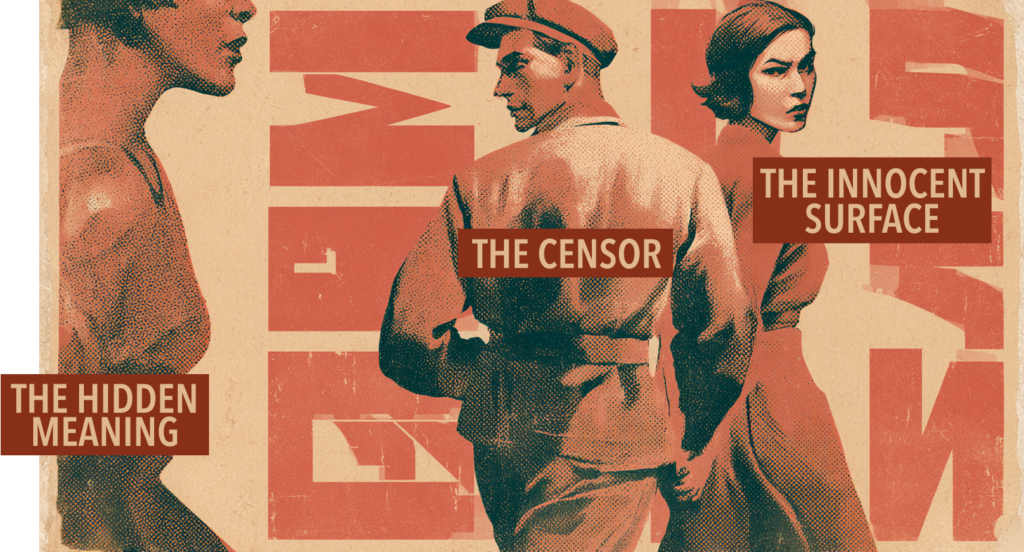
In the spirit of Ilya Kabakov: Soviet imagery tuned ever so slightly wrong. If you didn't recognize the setup, the image is working exactly as intended.“It’s just a meme” is exactly the same sentence as “the whole content is right there in plain sight.” Technically true, substantively insufficient. The meme’s apparent emptiness is not the opposite of meaning but a means of smuggling it, precisely like Kabakov’s bureaucratic chart.
And censors abound, even where the state does not intervene. The employer scrolls the profile. Relatives find their way somehow into every social channel. The algorithm moderates. A former (or current) partner is lurking. One’s own community polices the tone. Every public feed is a space where direct speech is expensive and deniable speech is cheap. This is why the meme naturally becomes Aesopian language: with it one can express difficult feelings that could not be borne if said outright. Depression is spoken of in dead and deep-fried memes whose surface is a joke and whose depth is a cry for help. And if the wrong person asks, the answer is always available: it’s just a meme.
With layered memes one can flip off one’s enemies so that only the enemy and the inner circle recognise the address, while any accusation of the meme’s malice can always be made to look like the accuser’s paranoia — the same trap, then, that the censor once stepped into. And with them one can speak of desire and sex by roundabout routes, so that the message’s tantalising charge arises precisely from its deniability. The recipient cannot always be entirely sure the message was really for them, and the sender can always retreat behind the surface. Flirtation is perhaps the oldest genre of deniability. The language of fans and of flowers was Aesopian language before Aesopian language — and the meme is its present-day dialect.
The thing itself has been in busy use since the world began. Many forms of slang, too, were originally deniability technology: thieves’ cant that the guards do not understand. And there wander among us surprisingly many people who believe that the various professions, likewise, use their in-house jargon for the same reason. That, however, is usually an overreading. Doctors, say, may on occasion use their professional idiom in a way that makes it hard for outsiders to follow, by accident or on purpose. But there are no actual double meanings in it. A language born in a surveilled space, by contrast, develops a double bottom almost every time.
IV. The Problem of Shared Keys
One thing separates dissident art from memes clearly: the management of keys. Aesopian language worked because the circle of the initiated was real and precisely bounded. Samizdat passed from hand to hand, the way of reading was learned within a community, and the writer could trust that the right audience would know how to open the right layer. Double coding was a precision weapon.
The keys of meme culture have scattered to the winds of the world. The same image circulates in thousands of contexts, and every community invests it with its own interpretation. Layers of irony pile up until, often, not even the poster knows anymore which layer is the actual message. For the same reason, the poster does not always fully understand what they are posting, or how it might be read in certain contexts.
The dissident knew what was hidden beneath the surface, and suffered from not being allowed to say it out loud. The inhabitant of meme culture can drift into the opposite condition: the surface is all that remains, and deniability, which began as protection, turns into a prison. When all expression passes through ironic processing, sincerity becomes impossible. The mask grows into the face. There is already a name for this — post-irony: the attempt to say true things in the form of irony, because the direct form has been lost. It is Aesopian language without a censor. A secret language that keeps its secrets even though no one demands it anymore.
There is, however, a technique by which the meme-maker can recover something of the key management that the endless circulation of content tends to take away. When several elements are combined into a single image — characters, frames, or text structures cut together from different source memes — reading the content requires that the viewer recognize all the references at once. This raises the interpretive threshold just enough for a somewhat bounded circle to emerge again. Only the one who knows all the original contexts reaches the full meaning, while the casual passer-by sees only a disjointed collage. This resembles, in miniature (and fractalized), the move that dissident art made at the level of the institution. Double coding is replaced by multiple coding, and every added element narrows the circle of the initiated by one more layer. It does not restore the dissident’s precision weapon, but it is the closest thing offered by a world where the keys have been fired around with a shotgun.
Then again, this very uncertainty can be a source of expressive power. Someone who posts a continuous stream of memes and embeds in it their feelings, their mockery, and their desires is doing no less than the dissident did. It’s just that, true to our times, the motives are no longer societal or communal but personal — at least in origin. They do the same thing without an institutionally guaranteed reading guide, trusting that the right people will recognize themselves as the message’s recipients. It is risky: the message can miss, hit the wrong target, or remain forever denied. From this follows an entirely new problem of its own: the unintentional or uncomprehending spread of outright harmful content. But we will deal with that in the next installment. Still, risk is part of the form, as it was in samizdat.
And on top of everything, the development of 2026 sharpens all this in a decisive way. Aesopian language worked because deniability was expensive and rare. The surface had to be built by hand, and it was precisely the amount of labor that made double coding a craft. But now that AI video has matured to the point where memes look indistinguishable from reality, deniability has become free and omnipresent.
Video, which for a brief historical moment was proof of reality, has turned into the number one tool of unreality. When nothing can be proven anymore, the censor loses his trap. He can no longer demand that the maker confess the hidden content, because the surface itself has ceased to be reliable. For the dissident’s strategy this is simultaneously a total victory and a total defeat. The protection has spread everywhere and, for that very reason, stopped protecting anything. Double coding, once a precision weapon, has dissolved into the default state of the environment.
The “mask grows into the face” phenomenon mentioned earlier acquires a concrete mechanism here. When deniability was laborious, it could be taken off. The dissident knew where the surface ended and the deep level began, because he had built the boundary himself. When deniability becomes the default of generated imagery, no one builds the boundary anymore, and therefore no one can dismantle it either. Sincerity does not become difficult; it becomes technically impossible. There is no longer a surface under which something could be hidden — only surfaces upon surfaces. In this landscape, Aesopian language keeps its secrets even after both the censor and the secret have disappeared.
V. Deniability as a Structural Element of Art
Dada could be blunt because it had nothing to lose (or so it rather endearingly believed). Dissident art was indirect because it had everything to lose. Meme culture is indirect because indirection has become the default of public speech.
Comparing these cases, something like a conclusion begins to take shape: art does not live in the layer of surface or the layer of depth, but in the tension between them. In the precision with which the maker builds a surface that withstands the gaze of the censor (the audience? the collector? the politician? the funder? the critic? the curator?) and a depth that rewards the more deeply initiated (who will hopefully be at least one of those same viewers).
Semi-automatic replication produces nothing but surface. But the moment someone begins to consciously control the distance between the layers and to define the relations between messages and the keys they require, the meme stops being slang and becomes what Aesopian language always was: a form in which freedom and coercion negotiate in public. The message is there for everyone to read, but no one can prove the existence of its hidden meaning.
In the landscape of 2026, this criterion only sharpens, because the entire economics of deniability has changed. When deniability was expensive, the craft lived in building the surface. Now that generated imagery makes deniability free, the surface is no one’s achievement. “That’s AI, you can tell by the pixels,” to paraphrase an old piece of internet folklore. Yet scarcity did not disappear. It just changed address. The one thing the machine will not hand out for free is the decision of who gets the keys and who is left staring at the surface. Aesopian language, then, did not die of deniability inflation. It became rarer than ever: everyone now knows how to deny, but hardly anyone hides anything anymore. “Jk jk. The boomer just doesn’t get it.”
Something larger than meme analysis follows from this. If we truly live amid a flood of content whose truthfulness is ever harder to prove, then the instrument that has been tuned the longest for reading precisely this kind of condition is (contemporary) art. The apparatus of conceptual art in particular has spent decades developing exactly the technology that the generated world now demands of everyone: multi-threaded interpretation, the parallel reading of parallel realities, separating claim from context, weighing truth values without final certainty. These are not insider games of the art world but the civic skills of the near future. The dissident learned them under duress, the conceptual artist in freedom — we will have to learn them, because soon there will be no alternative.
So if you want to raise your offspring to understand the world that is coming, one of the most important parenting tools appears, in all likelihood, to be a museum pass. And it wouldn’t hurt you either.
- Ville Kiiski
In the next part: ironic transgression acknowledges no colour. The same technique normalises prejudice regardless of who uses it, and from under which flag the shouting comes.
Leave a Reply